Canada’s CFR Credits Hit Historic $400 Milestone: What This Means for EV Fleet ROI
For the first time since the inception of the Clean Fuel Regulations (CFR), federal credit prices have officially crossed the $400 per credit threshold.
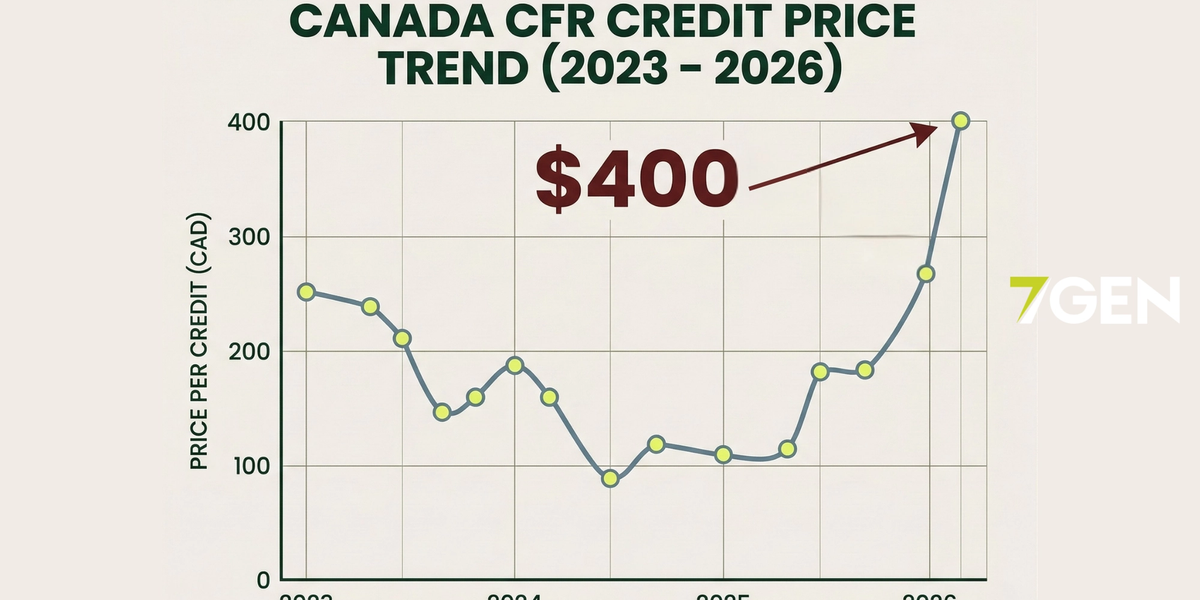
A graph showing the upward trend of carbon credit pricing in Canada.
The Canadian carbon market reached a fever pitch this morning. For the first time since the inception of the Clean Fuel Regulations (CFR), federal credit prices have officially crossed the $400 per credit threshold.
According to Seemant Karki, Lead Analyst, Decarbonization at 7Gen, this isn't just a number—it’s a signal. "Federal CFR credit (for the first time) has crossed $400 a piece according to market reports this morning." Karki noted. "We will be watching closely to see how the CFR market continues to develop in the months ahead!"
Why Are CFR Prices Skyrocketing?
The steady climb in credit prices reflects a tightening market. As fuel suppliers face increasingly aggressive carbon intensity requirements, the demand for high-quality compliance credits has outstripped supply.
This price surge highlights two critical market realities:
- Tightening Compliance: Primary fuel suppliers are working harder to meet federal mandates.
- The Role of Electrification: With low-carbon fuel solutions playing a vital role in decarbonizing transportation, electrification has become the primary engine for credit generation.
How This Benefits 7Gen Customers
For fleet operators, this price milestone transforms the economic math of electrification. High credit values directly translate to:
- Higher Revenue Potential: More value per credit generated means a faster path to profitability.
- Better Project Economics: Elevated credit prices can effectively "top off" or even replace traditional government incentives.
- Boosted ROI: Maintaining a strong Return on Investment (ROI) for EVs and charging infrastructure despite rising equipment costs.
- Incentivized Utilization: Higher prices encourage fleets to maximize charger utilization to capture every available dollar.
The Path Forward: A Maturing Market
This $400 milestone signals that the CFR market is maturing into a cornerstone of Canada’s clean fuel policy. For fleets, the message is clear: properly tracking and monetizing your credits is no longer "optional"—it is a core business strategy.
Related reading: Unlocking the Economics of EV Fleets with Carbon Credits
Ready to Electrify Your Fleet?
Get expert guidance on transitioning to electric vehicles. Our team is ready to help.
Get a Quote