Driving sustainability: Retailers can take charge and deliver change with zero-emission vehicles
To advance sustainability and carbon reduction, leading retailers are realizing that their buying power is a key driver in cutting their value chain emissions (scope 3 emissions). While the focus of retailers has traditionally been on emissions creat
Driving sustainability: Retailers can take charge and deliver change with zero-emission vehicles
To advance sustainability and carbon reduction, leading retailers are realizing that their buying power is a key driver in cutting their value-chain emissions (scope 3 emissions). While the focus of retailers has traditionally been on emissions created by their own products and operations (scope 1 and 2 emissions), they are now turning their attention to a crucial aspect of their organization’s carbon footprint: transportation and delivery. It’s becoming increasingly clear that to make a significant impact in reducing global emissions, retailers need to incorporate sustainability into their transport operations and procurement strategies, with a particular emphasis on incorporating zero-emission vehicles.. Learn more about sustainable last-mile delivery strategies.
As Angela Hultberg, the former head of Sustainable Mobility for IKEA Global, now the Global Sustainability Director at Kearney, wisely states, “To truly make a difference in our carbon footprint, we need to add the sustainability sticks into our transportation operations and procurement. It’s not just about the products; it’s about how we get them from point A to point B.”
This shift in mindset is critical, and many retailers are taking bold steps towards it.
One shining example comes from furniture retailer IKEA, which has set a commendable target of achieving 100 percent zero-emissions vehicles (ZEV) in their last-mile deliveries by 2025. This commitment to reducing emissions in their transportation fleet moves past their direct emissions to indirect emissions and demonstrates that sustainability is not just a buzzword for them, it’s a specific, ambitious and actionable goal.
So how can other retailers translate their vision of making an impact by reducing emissions into reality? It’s going to take more than good intentions.
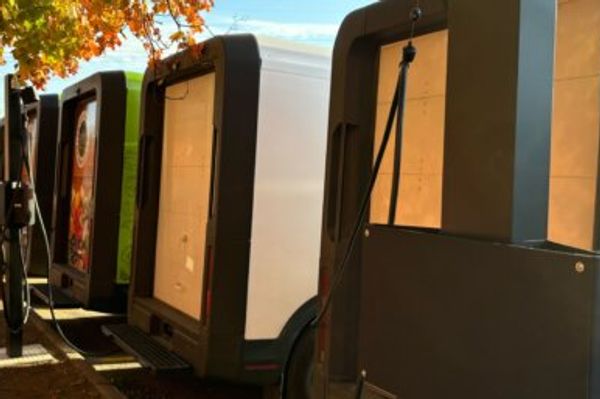
We picture EVs here that we recently delivered to Staples as they are a great example of a retailer taking action with both their own and outsourced delivery is 7Gen client Staples.
Staples turned to 7Gen, to tap our focused technology selection and deployment expertise. Starting with piloting two eTransits at a depot in BC, they more to follow. As the Senior Director responsible for Staples’ facilities, as well as sustainability, Leigh Pearson is a leader that understands both the bottom line and climate action imperative, as well as the challenge to tackle it all alone. “In order to meet our emissions reduction goals and reduce air pollution in our communities, these partnerships are critical.”
Decision-makers within shipping and retail organizations must prioritize deploying zero-emissions vehicles in their transportation supply chains, and to do so they should set specific transportation emissions reduction targets. We have to move beyond focusing solely on cost when evaluating transportation solutions; zero-emissions vehicles should be a scoring criteria in their transportation requests for proposals (RFPs).
To tackle this challenge head-on, not-for-profit organizations like The Smart Freight Centre have created the Sustainable Buyers Alliance. They recognize that to make substantial progress on indirect value-chain emissions, collaboration is key. Additionally the Aspen Institute established ZEMBA (the Zero Emissions Maritime Buyers Alliance) to seek bids for zero emission shipping services. Through this pilot, ZEMBA members will commit a portion of their demand for maritime shipping to zero-emission services. Bidders will vie for that aggregated demand of ZEMBA members, expected to reach 200,000+ TEUs, with delivery in 2025.
Back on road, and for deliveries in our communities, and between warehouses and stores, here’s why retailers should prioritize deploying zero-emissions vehicles as a crucial part of their sustainability strategy:
- The health of our communities: By adopting zero-emissions vehicles, retailers are actively contributing to the well-being of the communities they operate in. 30 per cent of Canadians live within 250 meters of a major roadway, where traffic-related air pollutants can be alarmingly high. Particulate matter from tailpipes, especially from medium and heavy-duty (MHD) transport vehicles, is a significant contributor to this problem. There is a need for cleaner air and zero-emissions vehicles play a pivotal role in achieving it.
- Clean technology exists: Clean technology for urban delivery routes is readily available today. It’s not a distant dream; it’s a reality waiting to be embraced. Companies like 7Gen are leading the way by “mobilizing the money and know-how” required to deploy zero-emissions vehicles and the supporting infrastructure. And Canadian companies like Lion Electric, Novabus and others from traditional OEMs and other EV focussed OEMs have created vehicles that can be deployed today.
- Make concrete progress on climate action, health and safety, and brand loyalty goals: beyond the obvious clean air and emissions reductions goals, time and time again the most cited benefit is the delivery driver job satisfaction. There is a pride in driving a quiet, emissions free vehicle. The reduced rattle and noise also has drivers less tired at the end of the day. These are important variables at a time of driver labour shortage, and increased health and safety concerns. Lastly, customer satisfaction with goods being delivered by these emission free vehicles has concrete correlation with repeat purchase and brand loyalty/satisfaction. In conclusion, retailers have a pivotal role to play in reducing indirect emissions, and deploying zero-emissions vehicles is a critical step in this journey. This will make a tangible impact on the environment and the health of our communities.
By working together and embracing innovative solutions like those offered by EVs-as-a-service (EVaaS) deployment partners like 7Gen, retailers can drive change and pave the way for a greener, more sustainable future in transportation.
Get started on your journey toward zero emission transportation and get in touch with a fleet electrification expert from 7Gen today!
Your go-to resource for a seamless transition to a zero-emission fleet.
Related reading: what your customers expect.
Ready to Electrify Your Fleet?
Get expert guidance on transitioning to electric vehicles. Our team is ready to help.
Get a Quote