Electric Last Mile Solutions: How Canadian Delivery Fleets Are Cutting Costs and Emissions
Last mile delivery accounts for up to 50% of total shipping costs, and it's the leg most exposed to fuel volatility and emissions pressure. Here's how Canadian carriers are using electric last mile solutions to cut per-delivery costs, meet urban emissions requirements, and build a more resilient fleet operation.

A last mile delivery driver prepares for the day's routes.
Last mile delivery is the most expensive and emission-intensive leg of the supply chain. It is also the stage that most directly affects customer satisfaction, since speed, reliability, and delivery accuracy all depend on how well the final mile performs. For Canadian carriers managing high stop counts in dense urban areas, the pressure to cut costs while maintaining last mile delivery services that meet rising customer expectations is growing fast. Electric last mile solutions are increasingly how forward-looking logistics operators are solving both problems at once.
Electric last mile solutions refer to the use of battery electric vehicles for short-distance urban delivery operations. For Canadian carriers and logistics operators, they offer lower fuel and maintenance costs compared to diesel alternatives. Combined with route optimization and fleet tracking technology, electric last mile vehicles can significantly reduce per-delivery costs while meeting urban emission requirements.
For a full overview of what fleet electrification involves from start to finish, see our guide on planning and executing an EV fleet transition.
1. What Are Electric Last Mile Solutions and Why Are They Growing in Canada?
Last mile delivery accounts for a disproportionate share of total supply chain cost, often cited as 40 to 50 percent of overall shipping expense, and a significant portion of urban emissions from commercial vehicles. Improving last mile delivery efficiency is one of the highest-leverage moves available to Canadian logistics operators.
Electric delivery vehicles address this directly. Battery electric cargo vans and delivery trucks produce zero tailpipe emissions, have fewer mechanical components than diesel equivalents, and cost significantly less to fuel and maintain on a per-kilometre basis. For a final mile carrier doing hundreds of short stops a day, those savings compound quickly.
Canadian adoption is accelerating for several reasons. Federal and provincial governments have set mandatory zero-emission vehicle targets for commercial fleets. Urban centres including Vancouver, Toronto, and Montreal are tightening emissions standards for delivery vehicles operating in core zones. And the cost gap between electric and diesel delivery trucks continues to close as battery technology matures.
Transport Canada's zero-emission vehicle programs outline federal commitments to accelerating the adoption of electric delivery vehicles and support available to businesses making the switch.
2. The Real Cost Problem in Last Mile Delivery Operations
Last mile delivery is expensive by nature. Urban congestion, high stop frequency, parking constraints, and return-to-hub cycles all drive up cost per delivery. Poor last mile delivery performance also damages customer satisfaction, as late or missed deliveries affect retention far more than disruptions elsewhere in the supply chain. Diesel delivery trucks compound all of this through fluctuating fuel costs and maintenance schedules that grow heavier with mileage.
For a last mile carrier operating at tight margins, the cost structure of a diesel fleet is difficult to sustain. Fuel alone can represent 25 to 35 percent of operating costs for delivery vehicles on urban routes. Add scheduled maintenance, unplanned repairs, and driver time lost to idling, and the economics become harder to justify year over year.
Electric vehicles change this equation meaningfully. Electricity costs per kilometre are consistently lower than diesel across all Canadian provinces. EVs have far fewer components that are subject to wear, which lowers both maintenance frequency and costs. For more on the numbers, see our breakdown of EV vs ICE maintenance costs for fleet operators.
3. How Electric Vehicles Solve the Last Mile Carrier Challenge
Range requirements for urban delivery routes
A common concern among final mile carriers is whether electric delivery vehicles can handle real-world urban route demands. For most Canadian last mile delivery operations, they can. The majority of urban last mile delivery routes fall within 100 to 200 kilometres per shift, well within the operational range of current electric cargo vans and light commercial trucks available in Canada.
Natural Resources Canada's electric vehicle resource centre confirms that modern battery electric vehicles offer driving ranges suitable for most urban and suburban commercial applications.
Charging overnight vs opportunity charging during shifts
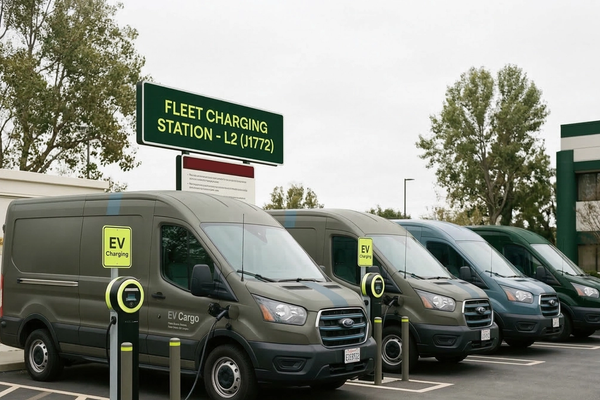
Most last mile carriers operate return-to-depot models, where delivery vehicles come back to a central location at the end of each shift. This makes overnight charging the simplest and most cost-effective approach. Vehicles plug in when they return and are fully charged by the next morning, ready for the next route.
For delivery trucks running multiple shifts or longer daily routes, opportunity charging during driver breaks can supplement overnight charging without requiring major additional infrastructure. The right approach depends on route length, shift structure, and available dwell time at the depot.
How EVs handle high stop-and-go delivery cycles
Urban last mile delivery involves constant stopping, starting, and low-speed manoeuvring. This operating pattern is actually well suited to electric vehicles. Unlike diesel engines, which run less efficiently at low speeds, EV motors deliver consistent torque from a standstill and lose minimal energy in stop-and-go traffic.
Regenerative braking, which recovers energy during deceleration, adds further efficiency in urban delivery cycles. This means electric delivery trucks perform better relative to diesel in exactly the conditions that make last mile operations most demanding.
4. Key Features to Look for in Electric Delivery Vehicles
Not all electric delivery vehicles are built for commercial last mile operations. When evaluating options for your fleet, prioritize:
- Cargo volume and payload: Match the vehicle's rated payload to your typical delivery load to avoid range degradation from overloading
- Range under load: Confirm real-world range figures under typical payload conditions, not just manufacturer maximums
- Charging compatibility: Ensure vehicles support standard Level 2 and DC fast charging connectors used across Canadian depot and public charging networks
- Cold weather performance: Canadian winters affect battery range. Look for vehicles with active thermal management systems that maintain battery performance in low temperatures
- Telematics integration: Built-in or compatible telematics allow last mile delivery tracking, battery monitoring, and route data collection from day one
- Electric last mile solutions designed for commercial use: Prioritize purpose-built commercial EVs over converted consumer vehicles for durability and serviceability at scale
5. How Last Mile Tracking Improves with Electric Fleet Technology
Real-time battery and range monitoring per vehicle
One of the practical advantages of modern electric delivery vehicles is the data they generate. Fleet managers gain real-time visibility into state of charge, estimated remaining range, and battery health for every vehicle in the depot. This removes guesswork from dispatch decisions and helps prevent vehicles from running short on charge mid-route.
Last mile carrier tracking with EV-integrated telematics allows dispatchers to assign routes based on available charge rather than assumptions, improving vehicle utilization and reducing the risk of unplanned downtime.
Route optimization based on charge levels
Electric fleet software can optimize route assignments dynamically based on current battery levels. A vehicle with a full charge can handle a longer last mile delivery route. One returning from a partial shift can be assigned a shorter top-up run before being queued for overnight charging. Last mile tracking at this level of granularity was not practical with diesel fleets, where fuel capacity was rarely a binding constraint. The result is a more responsive final mile delivery operation with better asset utilisation across the supply chain.
Route optimization software that integrates with EV telematics also accounts for charging stops, traffic, and delivery density, reducing total kilometres driven per delivery.
Reporting and data for logistics operators
Electric fleet platforms generate detailed data on energy consumption, cost per delivery, charging behaviour, and emissions reductions. This reporting is valuable for logistics operators managing client sustainability commitments, filing for carbon credits under Canada's Clean Fuel Regulations, or benchmarking fleet performance over time.
Final mile tracking data also helps identify inefficient routes, driver behaviour patterns, and vehicles that may need maintenance, all in a single dashboard. Faster issue resolution and more consistent last mile delivery performance directly improve customer satisfaction, since on-time rates and delivery accuracy are visible in real time. Fleet managers using platforms like those offered by 7Gen can integrate charging, vehicle, and route data in one place, reducing administrative overhead across the operation.
6. Making the Business Case for Electric Last Mile Solutions
The financial case for electric last mile solutions has strengthened considerably in Canada over the past three years. Lower fuel costs, reduced maintenance, and access to federal and provincial incentives combine to deliver competitive total cost of ownership compared to diesel for most urban delivery applications.
Key factors in the business case:
- Fuel savings: Electricity costs per kilometre are consistently 60 to 80 percent lower than diesel in Canadian provinces, depending on local electricity rates
- Maintenance reductions: EVs eliminate oil changes, transmission servicing, and exhaust system repairs, reducing scheduled maintenance costs significantly
- Incentives for delivery vehicles: The federal iMHZEV program provides purchase incentives for medium and heavy-duty zero-emission commercial vehicles, including delivery trucks. Provincial programs in BC, Quebec, and Ontario offer additional rebates
- Carbon credits: Canadian fleets operating electric delivery vehicles can generate credits under the federal Clean Fuel Regulations, creating an additional revenue stream
- Electric last mile solutions as a competitive differentiator: Retailers and e-commerce operators increasingly require sustainable delivery from their logistics partners, making EV fleets a factor in contract decisions
For a detailed breakdown of incentive programs by province, see our Canadian EV fleet incentives guide.
Where to Start with Your Fleet's Electrification
Canadian last mile and final mile carriers that move early on electrification are building operational advantages that will be difficult for later adopters to close. Lower cost per last mile delivery, cleaner supply chain emissions profiles, and access to incentives that may not remain at current levels all favour acting now.
For fleet managers ready to evaluate electric last mile solutions for their operations, the first step is a route and depot assessment to confirm range requirements, charging infrastructure needs, and financial projections. Working with a partner like 7Gen, whose all-inclusive EV-as-a-Service model covers vehicles, charging, maintenance, and energy management under one monthly cost, simplifies that transition for Canadian delivery fleets of any size.
Ready to Electrify Your Fleet?
Get expert guidance on transitioning to electric vehicles. Our team is ready to help.
Get a Quote