EV Charging Costs for Canadian Fleet Managers
Charging an electric fleet vehicle in Canada costs as little as $2.25 per 100 km, compared to nearly $20 for diesel. This guide breaks down the real cost of EV charging by province, explains demand charges, and shows Canadian fleet managers exactly what to budget for hardware, installation, and incentives.
EV Charging
For Canadian fleet managers evaluating the shift to electric vehicles, understanding how much electric car charging costs is the first and most important financial question. Fuel budgets are predictable, familiar, and easy to benchmark. EV charging costs feel less certain. This guide breaks down every component of the cost to charge an electric car in Canada, from per-kWh energy rates to hardware, installation, and the incentives that change the math in your favour.
The cost to charge an electric car in Canada ranges from $0.10 to $0.30 per kWh on a fleet depot Level 2 charger, depending on the province and utility rate. A typical commercial EV with a 75 kWh battery costs roughly $7–$22 to fully charge. Hardware and installation for a commercial charging station runs $5,000–$15,000 per unit before incentives.
The Real Cost of Charging an Electric Car vs. Fuelling a Gas-Powered Vehicle
The most direct way to evaluate EV charging costs is to compare them against what your fleet already spends on fuel.
A gas-powered cargo van averaging 12 L/100 km and driving 40,000 km per year burns roughly 4,800 litres annually. At $1.65/L (a reasonable Canadian average), that's $7,920 per vehicle per year in fuel alone, before maintenance. A gas car operating on the same duty cycle carries the same exposure to volatile pump prices.
An equivalent electric vehicle covering the same distance, consuming approximately 25 kWh/100 km, uses around 10,000 kWh annually. Electricity costs at a fleet depot rate of $0.12/kWh (typical for off-peak commercial charging in Ontario or Quebec) work out to $1,200 per vehicle per year in energy consumption, a fraction of gas-powered vehicle operating costs.
That's an annual cost saving of over $6,700 per van. Multiply that across a 10-vehicle fleet, and the case for electrification becomes hard to ignore. Unlike gas prices, electricity costs are more stable and easier to forecast, which matters when building a multi-year fleet budget.
What Determines Electric Vehicle Charging Station Cost: Hardware, Installation, and Ongoing Energy
The cost of electric car charging for a commercial fleet has three distinct layers: the charger hardware, the installation at your depot, and the ongoing energy costs you pay to your utility.
Upfront Hardware and Installation Costs for Commercial Fleet Depots
A commercial-grade Level 2 charger (the standard for overnight fleet charging) typically costs $1,500–$5,000 per unit for the hardware itself. DC fast chargers, used for mid-shift top-ups, range from $20,000 to $100,000+ depending on power output.
Installation costs vary significantly based on your existing electrical infrastructure. A depot with adequate panel capacity might add $1,000–$3,000 per charging port. Sites requiring panel upgrades, trenching, or utility service upgrades can push installation costs to $10,000–$50,000 or more for a multi-vehicle depot. Natural Resources Canada's electric vehicle charging infrastructure page outlines typical infrastructure requirements for commercial deployments.
All-in, fleet operators should budget $5,000–$15,000 per charging port before incentives for a well-planned Level 2 depot installation.
Demand Charges and Time-of-Use Rates: The Hidden Ongoing Cost
Per-kWh rates tell only part of the story. Commercial electricity bills in Canada often include demand charges, which are fees based on your peak power draw in a given billing period, not just your total consumption. If five vans plug in simultaneously at shift end, the resulting demand spike can add hundreds of dollars to a monthly bill.
Smart charging software, which staggers charging start times to flatten demand peaks, is not optional for fleets. It's essential cost management. Provincial and territorial energy profiles from the Canada Energy Regulator provide rate structures by region to help fleet managers model their specific exposure to demand charges.
How Much Does It Cost to Charge an Electric Car Per Kilometre in Canada
Per-kilometre cost is the most useful metric for fleet budgeting, as it maps directly onto how you already track fuel spend. Energy consumption varies by electric vehicle model, load weight, and driving habits, but 25 kWh/100 km is a reliable commercial baseline.
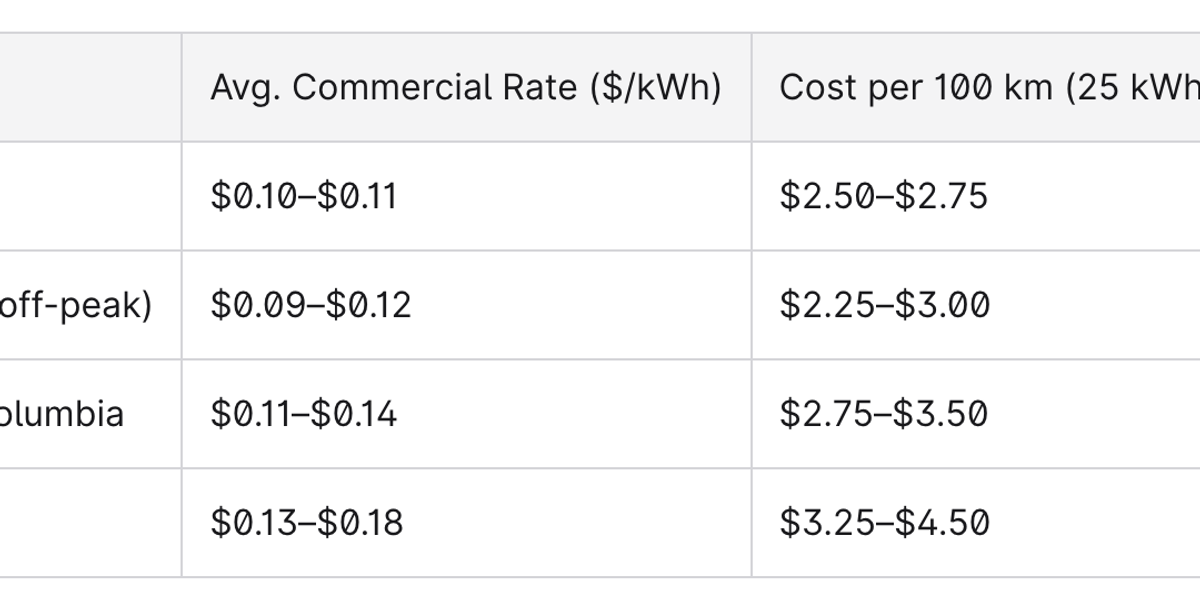
table price comparison charging vs fuel consumption
Compare these figures to a gas car at $1.65/L and 12 L/100 km: $19.80 per 100 km. Even in Alberta, Canada's most expensive province for commercial electricity, EV charging costs roughly one-quarter of equivalent gas-powered vehicle fuel spend.
For a fleet vehicle with a 75 kWh battery and a realistic driving range of 300–400 km per charge, a single charge costs between $7 and $22 depending on your province. That's a cost per kilowatt hour your fleet will pay consistently, without the volatility of gas station pricing.
Level 2 vs. DC Fast Charger: How Charger Type Affects Your Total Cost
The choice between Level 2 and DC fast charging shapes both your capital investment and your ongoing electricity bill. Charging speed and charging time vary significantly between the two, and so does cost.
Level 2 chargers (7–11 kW) are the right solution for fleets with overnight dwell time. Vehicles reach a full charge in 6–10 hours, and the lower power draw avoids triggering demand charges. This is the commercial equivalent of home charging: slow, efficient, and inexpensive per kilowatt hour. Most fleet depot charging happens here.
DC fast charging stations (50–350 kW) deliver a meaningful charge in 20–60 minutes, making them appropriate for fleets with multiple shifts, high daily mileage, or limited overnight dwell time. The trade-off is significantly higher hardware costs, greater installation complexity, and real risk of demand charge spikes if not managed carefully.
Fleet vehicles that need top-ups mid-route can access Canada's growing public charging network, including public charging stations operated by networks like FLO and ChargePoint, though per-kWh rates at public fast charging stations are typically $0.25–$0.45/kWh, notably higher than depot rates. Some charging networks also offer free charging at select locations, but this is not a reliable cost planning assumption for commercial fleets.
For most Canadian delivery and service fleets operating single shifts, Level 2 charging at the depot remains the most cost-effective approach: lower EV charger price, lower installation cost, and lower ongoing energy costs.
EV Charger Price vs. Total Cost of Ownership: What Fleet Budgets Should Actually Track
The sticker price of an EV charger is rarely what determines total cost. Fleet budgets should track:
- Hardware and installation (one-time capital cost per electric vehicle charging station)
- Annual energy costs (per-kWh electricity rates x annual energy consumption)
- Demand charges (dependent on charging behaviour, charging needs, and software)
- Maintenance and software subscriptions (typically $200–$600/year per charger)
- Incentive recovery (rebates and tax credits that reduce net cost)
Tracked together on a per-vehicle basis, most fleet operators find the true cost of charging electric cars runs 70–80% lower than equivalent gas-powered vehicle fuel spend when depots are properly configured.
An all-inclusiveEV-as-a-Service model, such as 7Gen's fleet leasing solution, bundles charging infrastructure, energy management, and maintenance into a single monthly payment, eliminating the need to track these costs separately. Learn more about how 7Gen structures EV fleet leasing for Canadian businesses.
Ready to Electrify Your Fleet?
Get expert guidance on transitioning to electric vehicles. Our team is ready to help.
Get a Quote