How Does an Electric Car Work?
Unlike vehicles with a gas engine, electric cars work by converting stored electrical power directly into motion, producing zero tailpipe emissions in the process.
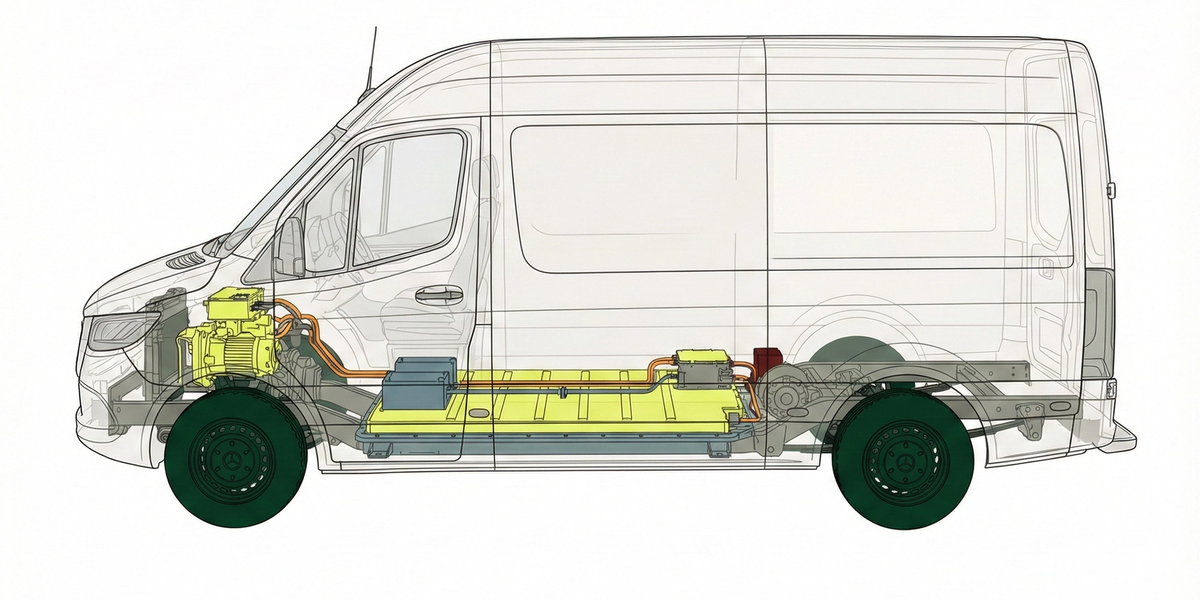
The engine and drive train of an electric cargo van.
Introduction: From Gas Tanks to Battery Packs
An electric car works by drawing electrical energy stored in a high-voltage battery pack, converting that power through an inverter, and delivering it to one or more electric motors that spin the wheels—all without burning a drop of fuel. There’s no gas tank, no exhaust pipe, and no rumbling engine. Just smooth, quiet propulsion powered by electricity.
Compare this to a diesel delivery truck or school bus running on an internal combustion engine. That diesel engine burns fossil fuels in combustion chambers, producing mechanical energy through thousands of controlled explosions per minute. The byproducts? Greenhouse gas emissions, particulate matter, and the constant drone of engine noise. Electric vehicles eliminate all of that. They produce zero tailpipe emissions and operate quietly enough to run early-morning routes through residential neighbourhoods without complaints.
Consider a 2025 electric step van completing its full urban delivery route in Vancouver on a single charge. The driver unplugs at 6 a.m. with a full battery, makes 80 stops across the city, uses regenerative braking at every traffic light to recapture energy, and returns to the depot with charge to spare. No fuel stops, no idling at intersections burning diesel, and significantly lower operating costs per kilometre.
At 7Gen, we help fleets of every size make this transition from ICE vehicles to electric. We bundle vehicles, charging infrastructure, fleet management software, and ongoing support into one predictable monthly payment—so operators can focus on running their business rather than managing the complexity of electrification.
What Is an Electric Vehicle and How Does It Work?
An electric vehicle (EV) uses electric motors powered by onboard batteries—or in some cases, fuel cells—instead of gasoline or diesel. Unlike vehicles with a gas engine, electric cars work by converting stored electrical power directly into motion, producing zero tailpipe emissions in the process.
The core energy flow is straightforward. Electricity is stored in a high-voltage battery pack, typically lithium ion batteries mounted low in the vehicle chassis for stability. When you’re ready to drive, power electronics convert the battery’s DC power into the alternating current the motor needs. The electric motor then transforms that electrical energy into mechanical energy, spinning a shaft connected to the wheels. Meanwhile, a separate low-voltage battery handles the vehicle accessories—lights, telematics hardware, climate controls, and infotainment systems.
When a driver presses the accelerator, the vehicle’s control system signals the inverter to deliver more electrical power to the motor. More power means more torque and higher speed. Release the pedal, and the system can reverse the flow, using regenerative braking to slow the vehicle while feeding energy back into the battery pack.
One of the most noticeable differences from a traditional engine is instant torque. Combustion engines need to build RPM before reaching peak power. Electric motors deliver maximum torque from a standstill. This makes for smooth, fast acceleration—particularly valuable when you’re merging a fully loaded delivery van onto a highway or pulling away from a stop in a refuse truck.
These same principles apply whether you’re driving a compact electric car or piloting a Class 8 electric truck. Medium- and heavy-duty electric buses and trucks simply scale up the system: larger battery packs measured in hundreds of kilowatt-hours and more powerful motors rated at 350 kW or beyond. The fundamentals remain identical.
Types of Electrified Vehicles
The term “electric vehicles” actually covers several powertrain types, each suited to different use cases and fleet strategies. Understanding the distinctions helps operators match the right technology to their operational needs.
Battery electric vehicles run entirely on electricity from the grid. They have no fuel tank, no exhaust system, and produce zero tailpipe emissions during operation. A BEV stores all its energy in a large battery pack and relies exclusively on charging infrastructure for replenishment. For fleets pursuing full decarbonization, BEVs represent the clearest path forward. As an example, several manufacturers introduced cargo vans in 2024 with usable ranges exceeding 300 kilometres—more than enough for most urban and regional delivery routes.
Plug in hybrid electric vehicles combine a smaller battery and electric motor with a gasoline or diesel engine. PHEVs can be charged from the electricity grid and typically deliver 30 to 80 kilometres of electric-only range before the combustion engine kicks in. They offer flexibility for operators not yet ready for full electrification, though they still produce tailpipe emissions when running on fuel.
Hybrid electric vehicles cannot be plugged in. Instead, they recover energy through regenerative braking and use the internal combustion engine to keep a small battery charged. HEVs improve fuel economy compared to conventional diesel vehicles, but they don’t eliminate emissions. They’re a stepping stone rather than a destination for fleets with sustainability targets.
Fuel cell electric vehicles convert hydrogen into electricity onboard, emitting only water vapour. FCEVs offer quick refuelling and long range, but hydrogen infrastructure remains limited across North America—especially for commercial fleets outside specific pilot corridors in California and parts of Canada.
For most commercial operators in Canada and the United States today, battery electric vehicles represent the practical choice. Vehicle options have matured rapidly across light-, medium-, and heavy-duty segments, and charging networks continue to expand. This is why 7Gen primarily deploys BEVs for fleet customers: the technology is ready, the economics work, and the infrastructure is buildable.
Core Components of an Electric Car
Electric vehicles have dramatically fewer moving parts than ICE vehicles—often 90% fewer. No multi-gear transmission, no exhaust after-treatment system, no oil changes. For fleets, this translates directly into reduced maintenance costs and less downtime.
The high-voltage battery pack serves as the vehicle’s fuel tank equivalent. Most electric vehicles use lithium ion batteries arranged in modules and mounted low in the chassis—usually in the floor—for optimal weight distribution and crash protection. Capacity is measured in kilowatt-hours (kWh). A compact electric car might carry a 60 kWh pack, while medium-duty trucks and school buses typically range from 120 to 300 kWh or more. Larger capacity means longer range, but also more weight and higher cost.
The electric motor is where electrical power becomes motion. Unlike a piston engine that relies on combustion, the motor uses magnetic fields to generate rotation. Current flows through stator coils, creating a rotating magnetic field that interacts with the rotor, producing torque. The result is smooth, continuous power delivery with instant torque available from zero RPM. Some fleet vehicles use dual motors—one per axle—for improved traction, better handling, and higher total power output.
The inverter and power electronics manage the critical conversion between battery power and motor demands. The battery stores DC power, but most traction motors run on alternating current. The inverter performs this conversion, precisely controlling voltage and frequency based on driver inputs. During deceleration, the system reverses: the motor acts as a generator, converting kinetic energy back into electrical energy that flows through the inverter to recharge the battery.
The onboard charger and charge port handle energy intake from external power sources. When you connect to a Level 2 charger, the onboard charger converts incoming AC power to DC for storage in the battery. DC fast chargers bypass this step, delivering DC power directly to the pack. The charge port—essentially the EV’s “fuel door”—includes communication protocols to manage charging safely.
Thermal management systems keep everything operating within safe temperature ranges. Lithium batteries perform best between 20 and 40 degrees Celsius. Overheating degrades cells and reduces battery life; extreme cold slows chemical reactions and limits available energy. Liquid cooling loops, pumps, and heat exchangers maintain optimal temperatures for the battery pack, power electronics, and motor—critical for reliable operation in Canadian winters and hot summer conditions alike.
Even fully electric trucks and buses still need a low-voltage system. A 12V or 24V battery powers lights, door actuators, telematics modules, and fleet management hardware. This auxiliary system operates independently from the high-voltage traction battery, ensuring essential functions remain available even when the main pack is at low charge.
Cobalt, Lithium, and New Battery Chemistries
Most commercial EVs today rely on lithium ion batteries, but not all lithium batteries are created equal. Older chemistries used cathodes containing 10 to 30 percent cobalt, which improved energy density and safety but raised concerns about supply chain concentration and cost volatility.
Early-generation electric passenger cars typically used 6 to 12 kilograms of cobalt per vehicle. For fleet operators managing dozens or hundreds of vehicles, those material costs added up quickly. Cobalt mining also carries environmental and ethical considerations that matter to organizations with ESG commitments.
The industry is shifting. Many fleet-oriented battery packs now use lithium-iron-phosphate (LFP) chemistry, which eliminates cobalt entirely. LFP batteries offer lower cost per kilowatt-hour, excellent cycle life—often exceeding 3,000 full charge cycles—and superior thermal stability. These characteristics make LFP particularly attractive for high-utilization delivery vans, school buses, and municipal fleets where vehicles charge and discharge daily.
Looking ahead, solid-state and sodium-ion batteries are progressing through development. Solid-state technology promises higher energy dense storage, faster charging, and improved safety by replacing liquid electrolytes with solid materials. Sodium-ion avoids lithium entirely, using more abundant materials. Both technologies are projected to reach commercial scale toward the late 2020s, potentially transforming fleet economics even further.
EV Batteries, Range, and Performance
Understanding battery specifications helps fleet operators make informed decisions. Two numbers matter most: kilowatts (kW) for motor power and kilowatt-hours (kWh) for battery capacity. Think of kW as horsepower—it determines how quickly the vehicle can accelerate. Think of kWh as tank size—it determines how far you can drive before recharging.
A light-duty electric van might use a 150 kW motor and 75 kWh battery, delivering around 350 kilometres of range under ideal conditions. A heavy-duty electric truck could pair a 350+ kW drivetrain with a 220 kWh battery pack—but loaded to capacity, that larger truck might only achieve 250 kilometres per charge. Bigger vehicle, bigger battery, but also more energy consumed per kilometre.
Real-world range differs from laboratory estimates. Factors that vary depending on your operation include average speed, urban versus highway driving, payload weight, route topography, and driver behaviour. A stop-and-go urban delivery route with frequent regenerative braking opportunities often delivers better efficiency than steady highway cruising at 100 km/h.
Cold weather presents particular challenges for fleets in Canada. Studies report 14 to 39 percent range reductions in extreme cold, depending on vehicle design and operating conditions. The car’s battery must power cabin heating in addition to propulsion, and cold temperatures slow the electrochemical reactions that release stored energy. Preconditioning—warming the battery while still plugged in—and heat pump systems help mitigate these losses, but winter operation requires realistic planning.
Regenerative braking recovers energy that would otherwise be lost to friction brakes as heat. When a driver lifts off the accelerator or applies the brakes, the electric motor reverses function, acting as a generator. This converts kinetic energy back into electrical energy, feeding it into the battery pack. On urban routes with frequent stops, regenerative braking can recover meaningful range—sometimes 15 to 20 percent of energy consumed. Downhill segments offer similar benefits.
For fleet operations, range and performance tie directly into route planning and total cost of ownership. At 7Gen, we use real duty-cycle data and telematics to size battery power and charging solutions correctly for each customer’s actual routes—not laboratory assumptions. This ensures vehicles can complete their assigned work reliably while optimizing infrastructure investment.
Charging an Electric Car: Levels, Speed, and Infrastructure
Charging is the EV equivalent of refuelling, but it works differently. Instead of a single trip to a gas station, charging can happen at depots overnight, at driver homes during off-hours, at customer sites during deliveries, or at public fast-charge hubs along highway corridors.
Level 1 charging uses a standard 120V household outlet. It’s the slowest option, adding roughly 5 to 8 kilometres of range per hour. For passenger electric cars parked overnight, Level 1 can work. For commercial fleets with daily routes exceeding 100 kilometres, it’s rarely sufficient as a primary charging method.
Level 2 charging operates at 240V and delivers 7 to 19 kW depending on the electric vehicle supply equipment installed. This adds approximately 30 to 60 kilometres of range per hour—enough to fully charge most light-duty electric vans overnight. Most North American fleets rely on multiple Level 2 charging stations installed at their depots, allowing vehicles to recharge during downtime between shifts.
DC fast charging (DCFC) bypasses the onboard charger entirely, pushing DC power directly into the battery at 50 to 350 kW or higher. At these speeds, a light-duty EV can add 150 to 300 kilometres of range in 30 to 60 minutes. Higher-power chargers—180 kW and beyond—are increasingly targeting medium- and heavy-duty electric trucks and buses that need rapid turnaround between routes.
Charging speed tapers after approximately 80 percent state of charge. This protects battery life by reducing stress on cells during the final charging phase. For fleet operations, this means most vehicles charge to 80 or 90 percent between shifts rather than waiting for 100 percent—optimizing both battery health and charger availability.
Canada’s public fast-charging networks continue expanding. Highways across British Columbia, Ontario, and Quebec now feature growing numbers of public chargers supporting intercity routes. These public charging stations complement depot charging for fleets that occasionally need to charge mid-route or extend their operational range.
From 7Gen’s perspective, designing the right charging mix matters as much as selecting the right vehicles. Depot charging handles overnight replenishment. Opportunity charging at customer sites or public fast chargers extends range for longer routes. We handle site design, electrical upgrades, permitting, and installation—so operators don’t need in-house electrical expertise to electrify their fleets.
Smart Charging, V2G, and Fleet Energy Management
Smart charging uses software to schedule when vehicles charge based on electricity demand, utility rates, and departure times. Instead of every vehicle drawing power the moment it plugs in—potentially straining transformers and triggering expensive demand charges—smart systems stagger charging across off-peak hours when electricity costs less and the electricity grid has spare capacity.
Bidirectional charging takes this further. Vehicles equipped for vehicle-to-home (V2H) or vehicle-to-grid (V2G) operation can discharge their traction batteries to supply electrical power back to a building or the grid during peak periods. EV batteries effectively become mobile energy storage assets, drawing cheap overnight electricity and potentially providing grid services or backup power during outages.
Grid impacts cut both ways. Unmanaged charging concentrated during evening peaks can overload local infrastructure. Coordinated depot charging and demand management can support renewable energy integration by absorbing excess solar or wind generation when available.
7Gen’s fleet software manages these dynamics. Our platform schedules charging windows, tracks energy consumption by vehicle, and integrates with utility tariffs to control operating costs. Fleet managers see when each vehicle will be ready, how much energy it consumed, and what it cost—without needing to become electricity market experts.
Maintenance, Reliability, and Battery Life
Electric vehicles typically cost 20 to 30 percent less to service than comparable ICE vehicles over their operational lifetime. The reason is mechanical simplicity: fewer moving parts means fewer components that can wear out or fail.
Routine maintenance on EVs focuses on a shorter list of items. Tires wear based on driving conditions and vehicle weight, same as any vehicle. Brakes last significantly longer than on conventional vehicles because regenerative braking handles most deceleration, reducing friction brake use. Cabin air filters need periodic replacement. Coolant in the thermal management system requires occasional service. Software updates—often delivered over-the-air—keep vehicle systems current without shop visits.
Most OEMs in North America offer high-voltage battery warranties covering 8 years or 160,000 kilometres, with some commercial programs extending coverage for buses and trucks that accumulate higher annual mileage. These warranties typically guarantee the pack will retain 70 percent or more of its original capacity over the coverage period.
Battery degradation happens gradually. Typical fleet-use EVs might lose 10 to 20 percent of usable capacity over 8 to 10 years of operation, depending on charging habits, climate, and utilization patterns. Telematics data helps fleet managers monitor state of health over time, enabling informed decisions about when to replace packs or transition vehicles to second-life applications where reduced range is acceptable.
Consider a practical example: a delivery fleet operating diesel vans might replace brake pads every 40,000 kilometres due to constant stop-and-go driving. The same routes in electric vans—with regenerative braking handling most deceleration—might see brake pads last 150,000 kilometres or more. Multiply that across dozens of vehicles, and maintenance savings compound quickly.
7Gen bundles scheduled service, remote diagnostics, and warranty coordination into our EV-as-a-Service model. Fleet managers receive predictable monthly costs without surprise repair bills, and our team handles the administrative work of coordinating with OEMs and service providers.
Business Case: Total Cost of Ownership and Fleet Electrification
Total cost of ownership for fleets includes more than the purchase price. A complete TCO analysis accounts for vehicle acquisition or lease payments, fuel or electricity costs, maintenance expenses, downtime losses, carbon pricing, and residual value at end of life.
Electricity is typically cheaper and more price-stable than diesel on a per-kilometre basis. In 2024, average diesel prices in Canada hovered around $1.50 to $1.80 per litre. Meanwhile, off-peak electricity rates in British Columbia and Quebec ranged from $0.06 to $0.12 per kilowatt-hour. For a medium-duty delivery van consuming 40 kWh per 100 kilometres, electricity cost works out to roughly $2.40 to $4.80 per 100 kilometres—compared to $25 or more for a comparable diesel vehicle.
Government incentives and carbon credits improve the economics further. Canada’s federal iMHZEV program offers incentives for medium- and heavy-duty zero-emission vehicles. Provincial programs in British Columbia and Quebec provide additional support. Low Carbon Fuel Standard credits can generate ongoing revenue for fleet operators who switch from diesel to electric. These incentives can offset significant portions of vehicle and charging infrastructure costs.
EVs also reduce unplanned downtime by eliminating failure-prone ICE components. No turbochargers to fail, no diesel particulate filters to clog, no multi-gear transmissions to rebuild. For fleets where every vehicle-day of downtime means missed deliveries and unhappy customers, reliability improvements carry real financial value.
Route suitability varies. Long-haul applications covering 600+ kilometres daily remain challenging with current battery technology. But urban and regional routes under 250 to 300 kilometres per day—which describes the majority of last-mile delivery, school bus, and municipal fleet operations—are often ready for electrification today.
7Gen’s EV-as-a-Service approach packages vehicles, charging infrastructure, software, maintenance, and energy management into a single monthly payment. This eliminates large upfront capital expenditures, converts costs from capex to opex, and simplifies budgeting. Fleet operators know exactly what they’ll pay each month, making electrification financially manageable for organizations of every size.
Choosing the Right Electric Vehicle for Your Fleet
Selecting the right EV starts with understanding your operational requirements. Fleet operators should assess daily and peak route distances, payload and passenger capacity needs, dwell times at depots that enable charging, existing grid capacity at sites, and long-term sustainability targets.
Different vehicle types align with different use cases. Light-duty electric vans excel at urban last-mile delivery with frequent stops. Class 6 electric trucks handle medium-duty applications like beverage distribution and food service. Class 8 tractors are entering production for regional haul and drayage operations. Electric school buses now serve districts across Canada and the United States. Shuttle buses and transit vehicles operate zero-emission routes in cities nationwide.
Starting with a pilot makes sense for most fleets. Rather than converting every vehicle at once, identify routes that are most “EV-ready” based on existing telematics data—routes with daily distances well within vehicle range, adequate dwell times for charging, and depot sites with sufficient electrical capacity. Prove the concept on these routes first, then expand systematically.
7Gen supports this process end-to-end. We conduct feasibility studies and route analysis to identify the best electrification candidates. We design and install charging infrastructure sized to your operations. We provide driver training so operators feel confident with new vehicles. And we monitor performance continuously, ensuring the technology delivers the business value you expected.
The Future of Electric Cars and Commercial Fleets
Global EV adoption is accelerating. By the mid-2020s, new EVs represent a rapidly growing share of vehicle sales worldwide. Canada has set targets requiring 100 percent of new light-duty vehicle sales to be zero-emission by 2035. Similar regulations apply to medium- and heavy-duty segments on slightly later timelines.
Charging infrastructure investment continues expanding. Federal programs across Canada fund corridor fast-charging and depot electrification projects. Private networks are building out highway charging for electric trucks. Utility companies in many regions offer support programs for commercial fleet charging installations. The infrastructure gap that once limited EV practicality is closing steadily.
Near-term technology improvements will benefit fleets directly. Battery energy density continues improving, extending range without adding weight. More efficient power electronics reduce losses. Megawatt-class charging systems under development will enable heavy-duty electric trucks to recharge in 30 minutes or less. V2G-ready vehicles will allow fleets to participate in grid services markets, generating additional revenue from parked assets.
Regulatory frameworks reinforce these trends. Zero-emission vehicle mandates in British Columbia and Quebec require increasing percentages of new vehicle sales to be electric. Corporate ESG commitments push logistics companies to decarbonize supply chains. Customers increasingly expect sustainable transportation options from their vendors and partners.
7Gen exists to help organizations navigate this transition successfully. We combine deep technical expertise with practical fleet operations experience, serving as an accountable partner that optimizes today’s operations while preparing for future technology shifts and regulations. Our integrated platform handles vehicles, charging, software, and support—so fleet managers can focus on their core business.
If you’re exploring fleet electrification, we’d welcome the opportunity to discuss your specific routes, vehicles, and goals. A tailored analysis from 7Gen can show you exactly how electric vehicles fit your operation—and what it takes to make the transition smooth, predictable, and profitable for generations to come.
Related reading: deep dive into EV battery technology | common myths debunked | how EV maintenance compares to gas vehicles.
Ready to Electrify Your Fleet?
Get expert guidance on transitioning to electric vehicles. Our team is ready to help.
Get a Quote