The TCO Reality: Why the Sticker Price of EV Fleets is Deceiving
The TCO equation isn't just about spending less; it’s about protecting earnings.
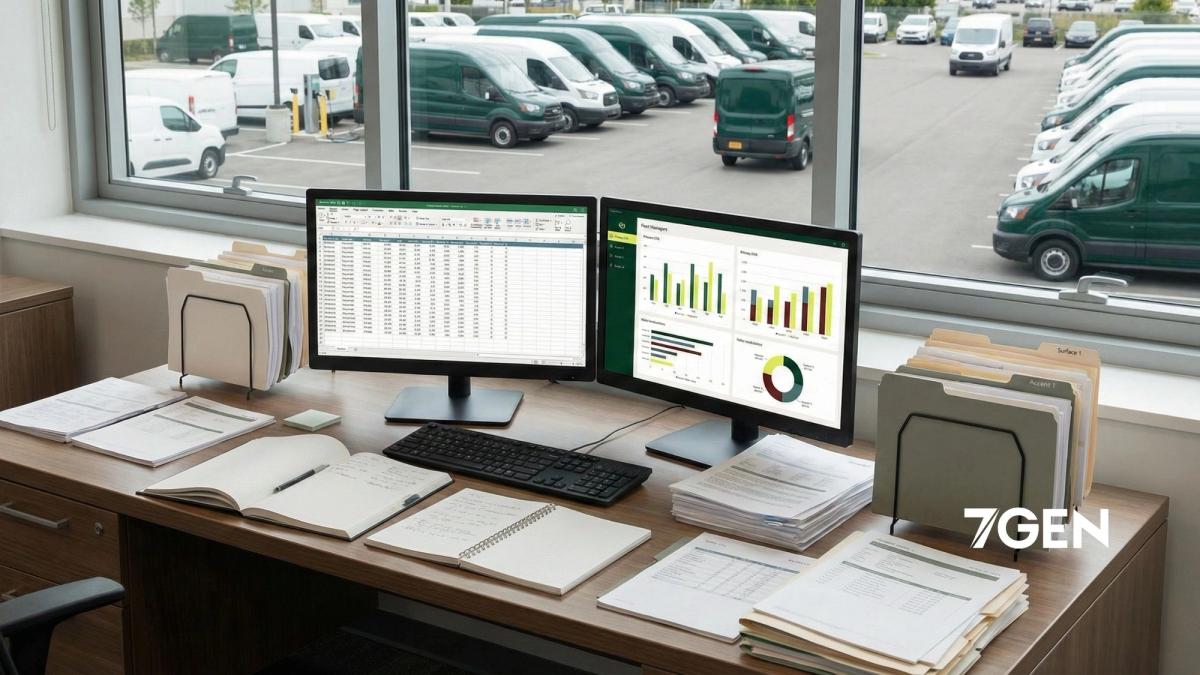
Fleet managers calculating the TCO of their EV fleet
For enterprise fleet managers, the capital expenditure (CapEx) required to purchase an electric vehicle can often trigger immediate pushback. When a Class 6 electric truck carries a higher purchase price than its diesel counterpart, the transition can seem financially daunting. However, looking at the sticker price in isolation is like judging a marathon runner by their first hundred meters.
To understand the true value of electrification, we must look at the Total Cost of Ownership (TCO). In a commercial context, TCO is the only metric that matters, capturing every dollar spent from the day of acquisition to the day of disposal over a 7-to-10-year lifecycle.
Breaking Down the Cost Categories
When evaluating the shift from internal combustion engines (ICE) to electric, the financial weight shifts from operating expenses (OpEx) to initial investment:
- Vehicle Acquisition: While the higher purchase price is a reality, it is increasingly offset by federal and provincial incentives, as well as specialized leasing options that spread the cost over the vehicle's life.
- Energy (Fuel): This is where the EV shines. Electricity costs per kilometer are typically 50–70% lower than diesel. In a world of volatile oil prices, electricity provides a stable, predictable cost floor.
- Maintenance: A simplified drivetrain—free of oil changes, transmission repairs, and complex exhaust systems—leads to a 30–50% reduction in maintenance costs. Furthermore, regenerative braking significantly extends the life of brake pads, further reducing routine service intervals.
- Infrastructure: The charging infrastructure is the most commonly overestimated barrier for EV fleet adoption. Fortunately, it is highly solvable with a variety of solutions that can be tailored to any business, from home charging, dedicated overnight charging, depot charging and public charging.
The Power of Incentives and Credits
The TCO equation isn't just about spending less; it’s about earning. In Canada, Clean Fuel Regulations allow fleet operators to generate carbon credits, essentially creating a new revenue stream for every kilometer driven on clean energy. When combined with utility incentive programs for managed charging (charging during off-peak hours), the financial gap between diesel and electric widens even further.
A 10-Year Comparison: Diesel vs. Electric
When you look at the long-term math* for a fleet of 10 medium-duty delivery trucks in Ontario, the shift from diesel to electric reveals a compelling financial narrative. A class 8 EV carries a higher upfront price tag in the ballpark of $950,000 for vehicles and charging infrastructure compared to the $650,000 diesel baseline. But those initial costs are quickly eclipsed by massive operational savings. Over a 10-year span, the electric fleet has the potential to slash fuel costs from $1.2 million down to just $450,000, while also cutting maintenance expenses in half. When you factor in roughly $200,000 in incentives and credits, the Total Cost of Ownership (TCO) for the electric fleet lands at $1.4 million, representing a staggering $850,000 in savings over the diesel fleet's $2.25 million total. Learn more about EV maintenance savings vs ICE.
Note: These are illustrative figures. Actual TCO depends on specific routes, local electricity tariffs, and operational patterns.
The Bottom Line
In this scenario, the electric fleet provides a $850,000 advantage over a decade. When packaged into a predictable monthly lease-to-own payment to help manage upfront costs, the long-term operational savings transformed a more expensive asset into a more profitable one.
At 7Gen, we don't believe in guesswork. We provide detailed TCO modeling using your actual route data and local electricity rates to build a precise comparison. Electrification isn't just about zero emissions, it's about being smart with your capital. Learn more about maximizing your ROI.
Related reading: calculate your own fleet's TCO.
→ Use our free TCO Calculator to compare EV vs. ICE fleet costs for your operation.
→ See how much your fleet could earn with our Carbon Credit Revenue Estimator.
Ready to Electrify Your Fleet?
Get expert guidance on transitioning to electric vehicles. Our team is ready to help.
Get a Quote