What You Need to Know About Canadian EV Fleet Incentives: While They Last
The EV fleet incentive landscape in Canada keeps shifting. Some major programs ended in 2025 and 2026, a new federal light-duty program launched in February, and British Columbia's biggest commercial rebate reopens August 10, 2026. This guide reflects the current status of every key program as of June 2026.
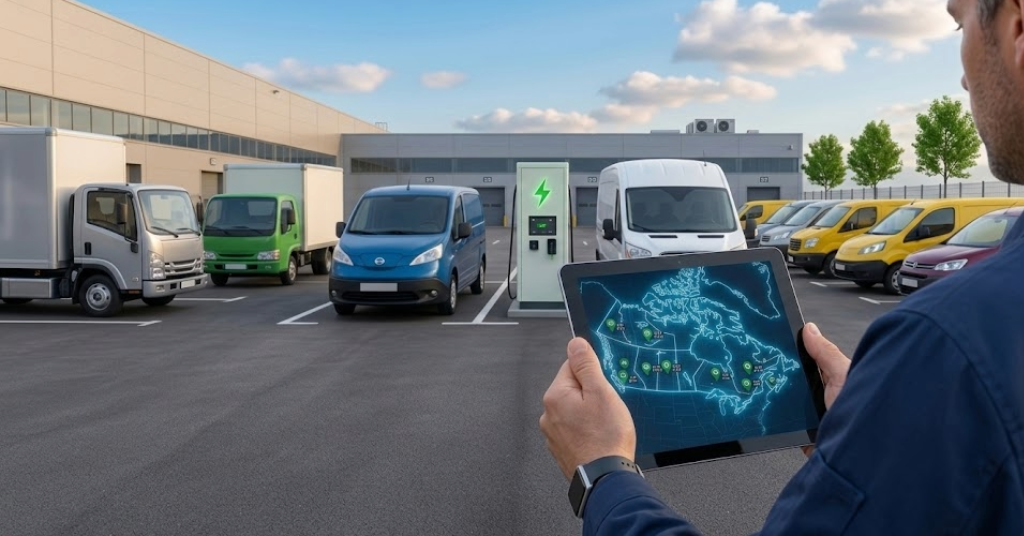
Fleet manager reviewing Canadian EV incentive map on tablet at commercial electric vehicle depot
The right move now depends on your vehicle class, your province, and timing.
Important: Verify the current status of every program directly with the relevant agency before making procurement decisions. Available funding changes rapidly.
Federal Programs
Electric Vehicle Affordability Program (EVAP): Active
The Electric Vehicle Affordability Program (EVAP) launched February 16, 2026, replacing iZEV. These federal incentives are provided at the point of sale for eligible light duty zero emission vehicles, applied by enrolled dealerships at purchase or lease:
- Up to $5,000 for battery electric vehicles (BEVs) and hydrogen fuel cell vehicles (FCEVs)
- Up to $2,500 for plug in hybrid vehicles (PHEVs)
These amounts decrease annually through March 31, 2031, so acting in 2026 secures the highest rate. Vehicles must be under 8,500 lbs, made in Canada or a free trade partner country, and have a final transaction value of $50,000 or less excluding GST and freight (no cap for Canadian-made vehicles). Fleets can claim up to 10 incentives per organization. As of June 1, 2026, about $2.13 billion of the $2.275 billion budget remains.
EVAP targets light duty vehicles, so it generally does not apply to Class 2b through Class 8 trucks. For medium and heavy duty fleets, provincial programs and carbon credit revenue are now the primary support.
iMHZEV Program (Medium and Heavy Duty): Ended
The iMHZEV program provided up to $200,000 per vehicle for heavy duty vehicles and other medium and heavy duty ZEVs, roughly half the price difference between an electric model and a comparable combustion one. It was capped at 75% of the manufacturer's suggested retail price (MSRP) when combined with provincial incentives, with a maximum of 10 incentives or $1 million per organization per calendar year. It ended March 31, 2026, with no federal replacement announced. Provincial programs like BC Go Electric Rebates, plus carbon credit revenue, now support heavy duty electric vehicles.
Zero Emission Vehicle Infrastructure Program (ZEVIP): Closed for Applications
The Zero Emission Vehicle Infrastructure Program (ZEVIP) funds charging stations and hydrogen refuelling stations across Canada, for public places, on street, workplaces, multi unit residential buildings, and fleets. All main streams closed to new applications on March 20, 2026, though the program is funded until 2027. Organizations apply through open calls for proposals, so check for a new intake before planning. When open, it can provide funding toward eligible costs for charging hardware. Charging infrastructure funding now varies by province.
Enhanced Capital Cost Allowance: Active
Canadian organizations can claim an enhanced first year capital cost allowance on eligible zero emission vehicles, combinable with EVAP. Confirm current limits with your accountant.
Provincial Programs
Provincial incentives vary by region. B.C. fleets can draw on the following programs to provide funding for vehicles and charging.
British Columbia
BC Go Electric Rebates (Medium and Heavy Duty): Reopens August 10, 2026
British Columbia's biggest commercial EV incentive is back. The CleanBC Go Electric Rebates program, paused in August 2025, reopens August 10, 2026, refreshed as a point of sale rebate for medium and heavy duty zero emission vehicles. It is the incentive program built for heavy duty electric vehicles in B.C. Pre approved customers get the rebate as a discount at the dealership when they pay. It is administered by CLEAResult Canada and funded by CleanBC.
Rebate amounts scale by vehicle class, from $5,000 per vehicle for Class 2b to $130,000 for Class 8. Indigenous communities and organizations, local governments, and non profit organizations get a 20% top-up, raising the Class 8 maximum to $156,000. Battery electric and hydrogen fuel cell vehicles qualify for the full amount; plug in hybrids at 50%. Only new vehicles on the official eligible vehicle list qualify, and pickup trucks are excluded. Businesses can claim up to 5 vehicles per year, and Indigenous organizations, local governments, and non profits up to 10. Vehicles must operate in B.C. for at least 48 months, and leases qualify with terms of 48 months or longer.
Funding releases on planned dates and closes temporarily if it runs out: August 10, 2026 (opening), December 10, 2026, and April 12, 2027. Rebates are first come, first served. Operators who took delivery of an eligible MHD ZEV during the 2025 pause may qualify retroactively.
For full amounts, eligibility, and how to get pre approved, see our guide: Go Electric Rebates Return August 10, 2026: What B.C. Fleets Need to Know.
BC Go Electric Fleet Charging Program: Active
This program provides financial support covering up to 50% of eligible costs for charging station purchase and installation (up to 75% for Indigenous communities and organizations), with rebates for installing both Level 2 and DC fast charging stations for fleet use, plus fleet and infrastructure assessments, electrical upgrades, and up to 40 hours of free advisory support through Plug In BC. Check the Go Electric BC Fleet Charging program to verify current intake.
BC Hydro Fleet Electrification Program: Active
The BC Hydro Fleet Electrification Program funds an EV ready fleet plan, covering 50% of planning costs up to $15,000 to assess fleet suitability, charging, and electrical infrastructure needs before you buy hardware.
Quebec
Roulez Vert (Light Duty): Active but Winding Down
Quebec's Roulez Vert program offers up to $2,000 for a new battery electric or hydrogen fuel cell vehicle in 2026, with amounts being gradually reduced. Operators acquiring BEVs can stack EVAP and Roulez Vert for up to $7,000 per light duty vehicle. Quebec's medium and heavy duty and infrastructure programs have been subject to suspension and review, so verify status directly before applying.
Manitoba
Electric Vehicle Rebate Program: Active, Extended in Budget 2026
Manitoba's Electric Vehicle Rebate Program, originally set to end March 31, 2026, was extended in Budget 2026. It offers $4,000 for a new EV and $2,500 for a used EV with an MSRP under $70,000, limited to one vehicle per purchaser. These passenger focused amounts rarely fit a commercial fleet but matter for light duty vehicles.
Other Provinces and Territories
Nova Scotia has offered rebates for Class 2B to 8 vehicles; verify current availability with the provincial administrator. The Yukon offers a $5,000 rebate for new battery electric, hydrogen fuel cell, and qualifying plug in hybrid vehicles with an electric range of 50 km or more. Other programs continue to evolve, so check current provincial pages.
Planning Your EV-Ready Fleet Transition
Before applying to any program, complete a fleet assessment to identify which vehicles suit electrification based on routes and duty cycles, your electrical infrastructure needs, and identify charging requirements by depot. An EV ready fleet plan strengthens applications for financial assistance and provides the documentation most programs require, including fleet size, vehicle class, and the overall business case for your zero emission fleet. It also lets you submit incentive requests fast when a window opens, which matters for first come, first served programs like BC Go Electric Rebates.
Carbon Credits: The Ongoing Revenue Opportunity
Unlike purchase incentives, carbon credit programs are not capped by funding limits or end dates in the same way. They are an ongoing revenue stream for fleets that cut greenhouse gas emissions by replacing combustion fuel with electricity.
The federal Clean Fuel Regulations (CFR) are active nationwide for operators who manage their own charging. Credits can be sold to offset operating costs. In B.C., the Low Carbon Fuel Standard adds credits on top of federal CFR, creating a stackable revenue opportunity.
Incentives lower the upfront cost, but the longer-term case matters too. Electric vehicles typically carry lower maintenance expenses than combustion engine vehicles, and over time the total cost of ownership can land below a comparable diesel or gas vehicle.
For how carbon credits work for Canadian fleets, see Unlocking the Economics of EV Fleets with Carbon Credits.
→ See how much your fleet could earn with our Carbon Credit Revenue Estimator.
The incentive landscape changes faster than any blog post can track. 7Gen helps Canadian fleet operators identify available incentives, stack programs, complete applications, and generate carbon credit revenue. For a broader overview, see How Government Incentives Support Your Transition to Fleet Electrification.
→ Use our free TCO Calculator to compare EV vs. ICE fleet costs for your operation.
Ready to Electrify Your Fleet?
Get expert guidance on transitioning to electric vehicles. Our team is ready to help.
Ready to Electrify Your Fleet?
Get expert guidance on transitioning to electric vehicles. Our team is ready to help.
Get a Quote