Why Delivery Drivers Are Switching to EVs (And Why the Holdouts Are Losing Money)
If you're still driving a gas van or eyeing a hybrid for your delivery routes, the math isn't on your side. Here's what every driver needs to know about the real cost of staying on gas.
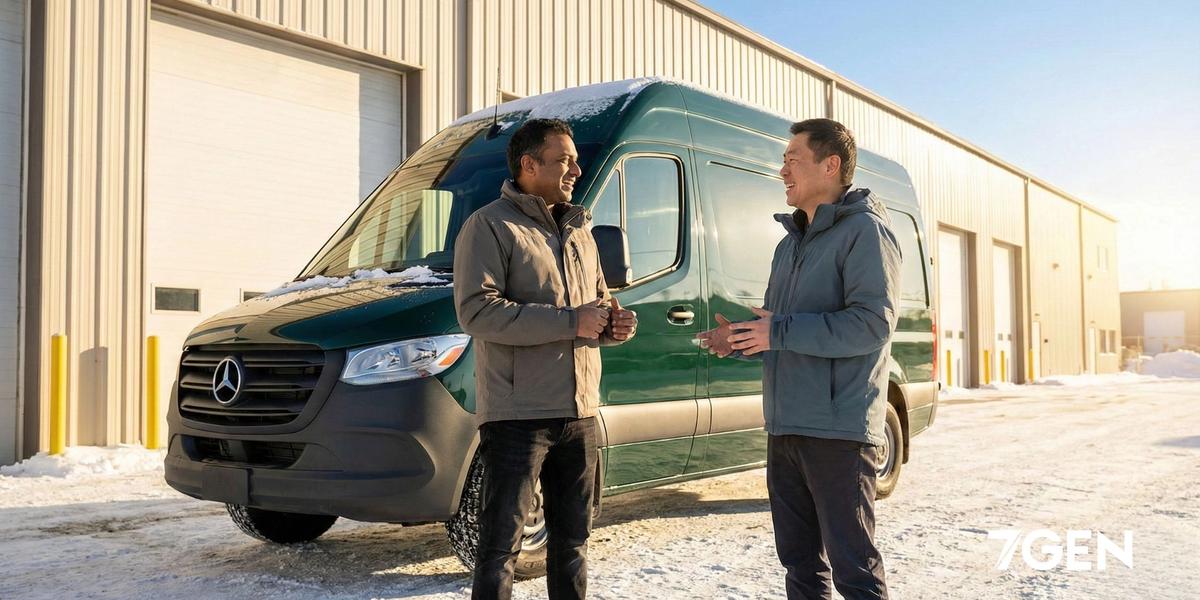
A 7Gen EV expert answers questions about last mile delivery.
Every week, we talk to delivery drivers who are skeptical about electric vehicles. They've heard the pitch. They've seen the headlines. But when it's their money and their livelihood on the line, the objections come fast: "Hybrids are cheaper." "I'll just buy a used gas van." "I only drive short routes—an EV is overkill." "I can't afford to be in the shop."
We get it. These are real concerns from people running real businesses. But here's the thing: when you move past the sticker price and look at what it actually costs to keep a vehicle on the road and earning, the picture changes completely.
This isn't about technology. It's about profitability.
Hybrids Sound Great Until You're Paying for Two Drivetrains
The hybrid pitch is appealing on the surface. Better gas mileage, lower purchase price than a full EV, and you still get to pull into any gas station you want. For a personal vehicle, that math can work. For a commercial fleet vehicle that's putting on serious miles? Not so much.
Here's what most people miss: a hybrid has two complete powertrains. You have an internal combustion engine and an electric motor, which means you have double the failure points. You're still paying for oil changes. You're still replacing timing belts. You still have a transmission that can fail. And when something does go wrong—and it will—you're maintaining and repairing two drivetrains instead of one.
The need to continue maintaining and repairing that ICE drivetrain negates the big benefit most people buy a hybrid for in the first place: lower operating costs. You might save a bit on fuel, but you're giving it right back at the mechanic.
With a full EV, there's no engine to blow up, no transmission to fail. One motor. One drivetrain. Radically fewer things that can break. Why pay to maintain two engines when you only need one to do the job?
The $15K Used Gas Van Is the Most Expensive Vehicle You'll Ever Own
This one comes up constantly. "EVs are too expensive. I'll just buy a used gas van for fifteen grand." And on paper, the upfront number looks great. Low capital expenditure. You're on the road fast.
But what you're really doing is buying someone else's maintenance headache. That low price tag masks serious operating risk. One transmission failure can wipe out three months of profit. One week in the shop doesn't just cost you the repair bill—it costs you every delivery you didn't make, every route you didn't complete. And if you're not reliably completing your routes, another driver will fill your place. That's lost income you never recover.
A leasing model like 7Gen's flips that equation. You get a new, safe vehicle with a warranty and predictable monthly costs. No surprise repair bills. No guessing whether the engine will make it through the week. It turns the risks of high-cost maintenance into a managed business expense you can plan around.
The question isn't "can I afford an EV?" It's "can I afford the downtime and unpredictability of an old gas van?"
Short Routes Are Actually Where EVs Make the Most Money
Here's one that surprises people: if you're driving short, dense delivery routes, you are the ideal EV driver. Range anxiety is a long-haul problem. For the driver doing under 200 kms a day in stop-and-go urban traffic, an EV is mathematically the best tool for the job.
Think about what happens in stop-and-go driving. Every time you brake, a gas vehicle turns that energy into waste heat. An EV captures it. Regenerative braking actually recharges the battery and saves your brake pads. You're not paying for gas capacity you never use. You're safer, you accelerate better in traffic, and your per-mile cost drops to almost nothing.
EVs are perfect for exactly the kind of routes most delivery drivers run every day: short distances, frequent stops, urban environments. That's where the efficiency advantage is enormous.
2,000 Moving Parts vs. 20: The Reliability Math Is Simple
When drivers tell us reliability is their top priority, we agree completely. If the wheels aren't turning, you aren't earning.
So let's talk about what "reliable" actually looks like under the hood. A gas engine has roughly 2,000 moving parts. An EV motor has about 20. No oil changes, timing belts or exhaust rust. No catalytic converter to steal. No head gasket to blow.
The best quote we heard recently was from a delivery driver for uniuni. When asked what she liked about it, she said: "I charge it and put tires on it. That's it."
That's not an exaggeration—that's the actual maintenance reality of an EV. If you want to stay out of the shop and on the road, the simplest machine is the smartest choice. Fewer parts means fewer things to break. Fewer things to break means more days earning. It's that straightforward.
What This Means for Your Bottom Line
Every driver's situation is different, but the underlying economics point in the same direction. Here's a quick breakdown of how the common objections map to the real business case:
If you want fuel savings and a low purchase price (the hybrid argument), the real issue is complexity. Two engines to fix versus one motor. More complexity means more cost over time.
If you want a cheap vehicle right now (the used gas van argument), the real issue is predictability. Used vans mean unpredictable repair bills that can torpedo your monthly earnings.
If you drive short routes and think an EV is overkill (the part-timer argument), the real issue is fit. Short, dense routes are the most efficient use case for EVs, not the least.
If you need reliability above all else (the pragmatist argument), the real issue is uptime. Two thousand moving parts versus twenty. The simpler machine keeps you on the road.
The Shift Is Already Happening
The delivery drivers who are making the switch aren't doing it because they love technology or want to save the planet (though those are fine reasons too). They're doing it because they ran the numbers. They looked at total cost of ownership—fuel, maintenance, downtime, repair risk, lost income—and the EV came out ahead.
The conversation has moved past "is an EV good enough?" to "can I afford not to be in one?"
If you're running delivery routes and still on the fence, the best thing you can do is look at your actual costs. Not just the sticker price. Not just the fuel bill. Everything. The repairs, the downtime, the routes you miss when your vehicle is in the shop. When you see the full picture, the decision gets a lot simpler.
Frequently Asked Questions
Are hybrids a good compromise for delivery drivers?
Hybrids can save on fuel, but for commercial use, they come with a significant drawback: two complete powertrains to maintain. You still have an internal combustion engine with all its maintenance requirements—oil changes, timing belts, transmission risk—plus an electric motor system. For personal driving, a hybrid can be a reasonable choice. For commercial delivery routes where uptime and low operating costs are critical, the dual-drivetrain complexity typically costs more than it saves.
How does an EV lease compare to buying a used gas van?
The upfront cost of a used gas van is lower, but operating costs are unpredictable and often higher. A single major repair like a transmission failure can eliminate months of earnings, plus you lose income while the vehicle is in the shop. An EV lease through a provider like 7Gen gives you a new vehicle with a warranty, predictable monthly costs, and drastically lower maintenance requirements. When you factor in fuel savings, reduced maintenance, and eliminated downtime risk, the total cost of ownership often favors the EV lease.
Do EVs have enough range for delivery routes?
For most urban and suburban delivery routes—typically 80 to 150 miles per day—modern EVs have more than enough range. Short, stop-and-go routes are actually where EVs perform best, thanks to regenerative braking that recaptures energy during frequent stops. Range anxiety is primarily a concern for long-haul highway driving, not for the dense route patterns most delivery drivers operate in. Having a reliable home or depot charging setup makes range a non-issue for the vast majority of delivery work.
What maintenance does an EV actually need?
Compared to the roughly 2,000 moving parts in a gas engine, an EV motor has about 20. There are no oil changes, no timing belts, no transmission fluid, no exhaust system to rust out. Routine EV maintenance typically comes down to tires, brakes (which last longer thanks to regenerative braking), windshield washer fluid, and cabin air filters. Many EV delivery drivers report that charging and replacing tires are essentially their only regular vehicle expenses.
Is an EV worth it if I only drive part-time?
This depends on your specific situation. If you're driving short routes regularly, an EV can still be highly cost-effective because short urban routes are where EVs are most efficient. However, the economics depend on whether you're generating enough revenue to justify a lease payment. For drivers who plan to scale up their delivery work, starting with an EV positions you for higher profitability as your route volume grows, since your per-mile operating cost will be significantly lower than a gas vehicle.
Related reading: solving last-mile logistics with EVs | sustainable delivery expectations.
Ready to Electrify Your Fleet?
Get expert guidance on transitioning to electric vehicles. Our team is ready to help.
Get a Quote